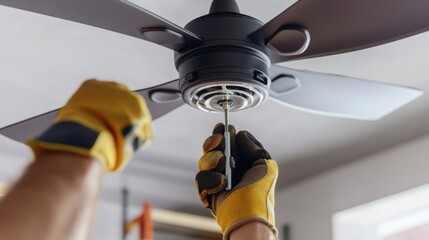
The instructions included in this guide should be used as supplemental material to the model-specific ceiling fan manual provided with your Hunter product. Verify the electrical box in your ceiling is rated for ceiling fans.
Modern homes have a wide variety of devices that require a robust electrical infrastructure. Electrical service upgrades from Nash Electric LLC ensure safety, efficiency, and code compliance.
Installation
Incorrectly mounting or securing ceiling fans can lead to fan failure, which can result in loss of power and potentially dangerous injuries to people or property. Typical errors include misconfiguring wall switches so that the fan and light share the same circuit, which reduces energy efficiency and makes troubleshooting more difficult down the road. Additionally, many homeowners make the mistake of failing to properly label or document which wires are connected to which terminals—a simple step that makes future repairs and upgrades far easier.
Most of the time, improper installation of ceiling fans is due to poor electrical wiring. Regardless of the type of fan, all electrical wiring must comply with national and local electrical codes. A faulty wiring job can lead to overheating and fire, which is why it is important to hire an electrician for all electrical projects, including swapping out ceiling fans.
Before beginning any work, turn off the power at the breaker and wall switch for the fixture being replaced. A voltage tester can help ensure that the circuit is de-energized before starting, and insulated screwdrivers and pliers will keep you safe when working in tight spaces or around live wires. A sturdy ladder that can support your weight while you work should also be used for safety reasons.
It is also important to ensure the new fan can safely fit into the existing outlet box. The motor and other components can be quite heavy, so the electrical box must be rated to handle the load of a ceiling fan. If the box is not rated, you may need to install an additional breaker or add a splice in order to safely attach the fan.
Direct-drive motors use a stationary inner core with a shell made of cast iron, cast aluminum, or stamped steel that revolves around it, and the blades are attached directly to the shell. This type of motor is less expensive to produce but has a greater tendency to generate noise and can be more prone to failure. Fortunately, more and more manufacturers are now using rotor technology, which eliminates the rotating inner core and instead uses a metal hemisphere or ball that rests in a ceiling-mounted bracket, called a ‘canopy’.
Wiring
Depending on your ceiling and how you want to control your fan, there are various wiring options. Some fans are designed to be operated with a single pull chain to power both the fan and light, while others can be controlled separately by either a remote or wall switch. Some fans can also be wired to operate via a smart home setup, and these can work with your phone or voice assistant to help manage the fan’s settings.
For most new installations, the best option is to use a single, dual-gang wall switch. This will give you the ability to turn on the fan and light with a single switch or set them to different speeds, giving you more flexibility in how you use your room. This type of switch is more expensive than a standard single-gang, but it is worth the extra cost for the added features.
When connecting the wires, make sure you use a quality tool. A good pair of wire strippers will save you a lot of time and effort, and will also help ensure that your wiring is up to code. It’s also a good idea to wrap the end of each wire with electrical tape, just to be safe. This will keep the bare metal from touching other metal parts of the fixture and avoid any shorts or sparks when you use the fan.
Before connecting the new wires, make sure you have the right size breaker for your fuse box. Some fans require a specific breaker to prevent overheating and other issues. If you are unsure of what breaker you need, consult a professional electrician or your local hardware store for assistance.
Once you have the breaker installed and have all your wires connected, it’s time to test your fan. You can do this by running it for a few minutes and then letting it cool off for 30 seconds or so. This will allow the blades to settle into place and will help you determine whether your fan is balanced.
If your fan is unbalanced, you can try re-balancing the blades or replacing the motor. However, if the problem persists, you may need to call an electrician for further testing and/or repairs.
Testing
A well-installed ceiling fan will run quietly and move air smoothly. Homeowners in Central Florida rely on fans to help manage electricity costs and provide extra comfort during the warmer months. But a poorly installed fan can turn into a daily frustration or even a safety hazard.
A wobbly fan is almost always a bad sign, and it can indicate that something was mounted or wired incorrectly. In many cases, the problem is a simple as an unbalanced blade or a non-rated electrical box that can’t hold the weight and movement of a fan. In other cases, the issue may be more serious like a loose bracket or crooked mounting screws that can eventually result in a ceiling fan detaching from the ceiling and causing injury.
Another common fan installation problem is when a fan is mounted too close to the floor. Building codes across the United States and elsewhere typically instruct homeowners to mount their fans high enough so that the blades are no closer than seven feet from the ground. But some do-it-yourselfers can get confused about which height is correct and install a fan lower than the building code recommends. A fan that’s mounted too low can hit a person’s head when they extend their arms to reach items hanging on the wall or from above, such as clothing, bedsheets, and plants. In such a case, it’s important to hire a licensed electrician for an inspection and repair.
Manufacturers can take steps to avoid such safety issues by partnering with a BIS-recognized testing laboratory. A qualified lab can conduct ceiling fan ISI testing under controlled conditions, verifying insulation resistance, dielectric strength, temperature rise, mechanical stability, and performance under abnormal operation. Duct fans must undergo additional tests focusing on motor heating, protection against access to live parts, and safety in hazardous locations.
Pedestal and table fans combine mobility with power, so they must pass tipping and overheating tests. Partition fans and wall fans require precise mechanical safety evaluation, including enclosure integrity, blade strength, and endurance performance under operational stress.
Inspection
A home’s ceiling fans combine both electrical and mechanical power. This mix creates a variety of conditions that affect fan reliability and performance. These include dust buildup, vibration, loosening of internal components, and more. To avoid damage and unexpected breakdowns, regular maintenance routines and inspections are essential.
Ceiling fans can benefit from twice-yearly maintenance checks that prepare them for seasonal use and improve airflow efficiency. These maintenance tasks also ensure that reversing switches function properly and mounting hardware remains secure. This consistent approach helps homeowners prevent issues like wobbling, which reduces performance and can cause injuries.
During maintenance, all power to the fan must be isolated at the circuit breaker. This precaution eliminates the risk of accidental activation by a faulty switch, remote control, or wiring defect. Stable ladder positioning and the wearing of protective eyewear further minimize the risk of accident and injury.
The initial inspection of a ceiling fan should focus on visual and operational conditions. Problems such as dust accumulation or slow response to operation signal emerging electrical or mechanical problems. These issues can erode motor performance, strain wiring, and increase energy consumption. Homeowners should note any changes in sound, speed consistency, or responsiveness and schedule a follow-up service call.
When a ceiling fan is out of balance, it produces a distracting wobble that increases stress on mounting hardware and internal bearings. A common cause of imbalance is uneven distribution of weight among blades, warping, or loose screws. Homeowners can correct this issue by using a yardstick or other tool to measure the distance between the tips of each blade, then manually bending misaligned blade irons back into place.
A final check of the fan is to verify that the motor wires are connected correctly. A quick test can reveal loose or incorrectly connected wires. This is a good opportunity to check for proper color coding as well.
As with any electrical work, improper installation techniques or lack of professional experience presents inherent risks to the health and safety of your home. In addition to a range of potential injuries, improper electric work can lead to fires and other serious property damage. While a ceiling fan installation might seem simple, this project requires extensive knowledge of electricity and adherence to safe electrical work practices. Hiring a certified electrician, such as the professionals at Crimson Power, brings skill and expertise in code compliance, safe installation techniques, and best practice guidelines for residential electrical projects.